This post may contain affiliate links. If you click on these links and make a purchase, I may earn a small commission at no extra cost to you. I only recommend products I believe provide value. Thank you.
Cordless kitchen appliances are becoming increasingly popular, especially for people who want flexibility without being tied to a power outlet. The Camic Cordless Immersion Blender is marketed as a portable, easy-to-use solution for making smoothies, soups, and quick blends anywhere in the kitchen or even outdoors. In this review, I break down its real-world performance, including blending power, battery life, ease of cleaning, and overall value. Instead of relying on marketing claims, this review focuses on practical use so you can decide whether it truly fits your cooking needs.
Table of Contents
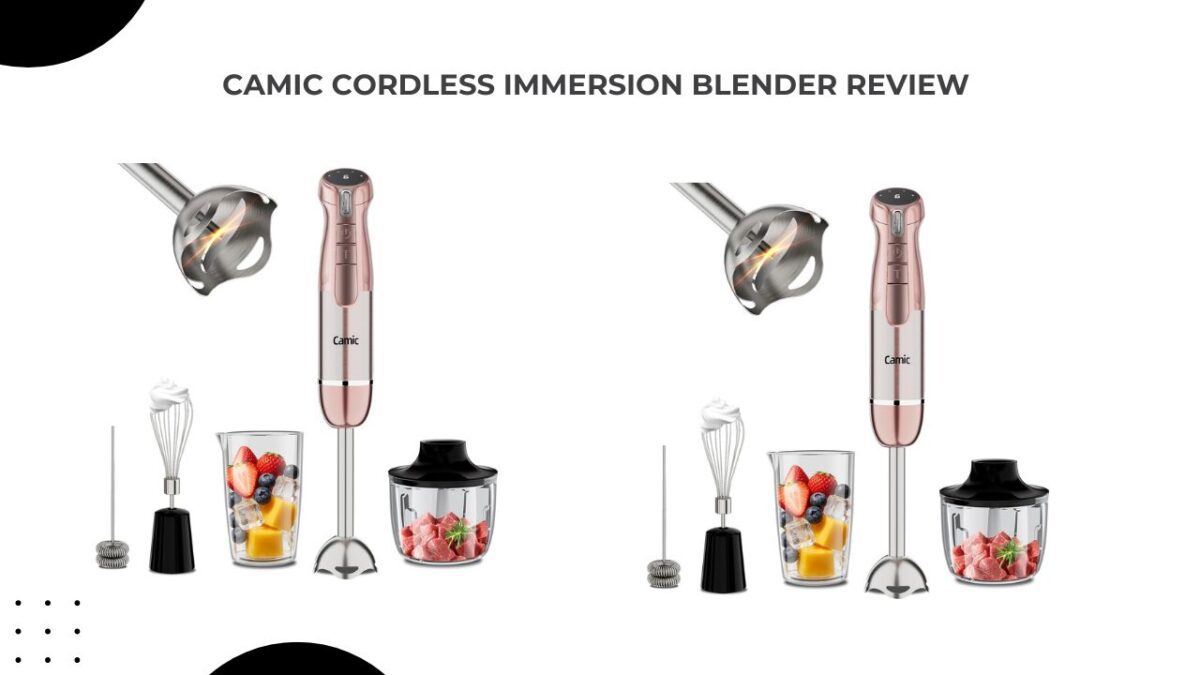
Camic Cordless Immersion Blender Review
When I first came across the Camic cordless immersion blender, I honestly didn’t expect much beyond the usual “it works fine” kind of kitchen gadget. There are so many stick blenders out there that all claim convenience and power, but most end up feeling either underpowered or just awkward to use. After spending time with it and looking at how it actually fits into real kitchen routines, this Camic Cordless Immersion Blender is less about hype and more about where this tool genuinely fits and where it doesn’t. Because that’s really the key question here: is it actually worth adding to your kitchen, or is it just another gadget that sounds better than it performs?
First impressions: simple, lightweight, and very “grab and go”
The first thing you notice about the Camic cordless immersion blender is how straightforward it feels. There’s no complicated setup, no heavy base, and definitely no cord to deal with. It’s one of those tools you can literally pick up and start using within seconds. That might sound small, but in real kitchen use, that convenience matters more than people think.
A lot of immersion blenders end up stored away because they feel like a hassle plug this in, find an outlet, deal with cord length, then clean up extra parts afterward. With this one, it feels more natural to just reach for it when needed. It also has a lightweight feel, which makes it less intimidating if you’re not used to using stick blenders often. It doesn’t try to feel like a professional kitchen tool, it feels more like a home kitchen helper.
That said, lightweight also raises the first question: does it sacrifice too much power for convenience? We’ll get into that later.
Design and build: built for convenience, not complexity
Looking at the design of the Camic cordless immersion blender, it’s clear the focus is ease of use. The handle is shaped in a way that feels comfortable enough for short blending tasks. It’s not bulky, and it doesn’t have that “over-engineered” feel some kitchen appliances have where they try to do too much at once.
One thing I appreciated is that it doesn’t feel cluttered with unnecessary buttons or confusing attachments. You’re not spending time figuring out how to use it, you just use it. However, if you’re someone who likes a more premium, solid metal feel in your kitchen tools, you might notice that this leans more toward practical plastic construction rather than high-end durability materials.
That’s not necessarily a bad thing, it just reflects the price and positioning of the product. It’s clearly aimed at everyday users, not professional chefs.
The real selling point: cordless freedom in the kitchen
The biggest reason people even consider a cordless immersion blender like this is simple: freedom.
And honestly, this is where the Camic model makes the most sense. With traditional immersion blenders, you’re constantly working around a cord. You either need to be close to an outlet or deal with dragging the cable across your counter while trying to blend soup in a pot.
With this cordless design, that entire issue disappears.
You can:
- Blend soup directly on the stove without rearranging your kitchen setup
- Move between bowls and containers freely
- Blend in awkward spaces without worrying about outlet distance
- Use it outdoors or anywhere without power access
It’s one of those features that doesn’t sound life-changing on paper, but once you get used to it, going back to a corded blender actually feels restrictive. That said, cordless convenience always comes with a trade-off, and in this case, it’s mainly about power consistency and runtime.
Performance for smoothies, soups, and everyday blending
This is where the Camic cordless immersion blenderbecomes more practical and less theoretical.
For light to moderate tasks, it performs well enough.
- Smoothies
For soft fruits, yogurt-based smoothies, or liquid-heavy blends, it does the job without much struggle. You’re not going to get the same ultra-smooth, restaurant-level texture as a high-powered countertop blender, but for quick home smoothies, it’s perfectly usable.
- Soups
This is actually where it feels most at home. Blending soups directly in the pot is where immersion blenders shine in general, and the Camic model handles this comfortably as long as the ingredients aren’t overly dense or fibrous.
- Sauces and dressings
For smaller kitchen tasks like salad dressings, sauces, or emulsions, it works smoothly. These are exactly the types of jobs it seems designed for.
Where it struggles
Now, this is important to be honest about. If you try to push it into heavier territory like thick mixtures, frozen fruits, ice crushing, or large batches, you’ll start to notice its limitations. It’s not weak for its category, but it’s not a powerhouse either. It sits firmly in the “everyday convenience blender” category, not the “heavy-duty blending machine” category.
Handling and comfort: surprisingly important in real use
One thing people often overlook with immersion blenders is how they actually feel in your hand after a minute or two of use. That matters more than specs.
The Camic cordless immersion blender is fairly easy to hold, especially for short tasks. Because it’s lightweight, your wrist doesn’t get tired quickly during quick blending jobs. However, balance is something you start noticing when you use it for longer sessions. Cordless designs sometimes shift weight toward the handle due to the battery, and while this model handles it reasonably well, it’s not perfectly balanced like higher-end units.
For quick kitchen tasks, though, it’s absolutely fine.
This is not a tool you use for 10–15 minutes continuously. It’s more of a “30 seconds here, 1 minute there” type of appliance.
Battery life and usability expectations
Battery performance is one of those areas where expectations need to be realistic. The Camic cordless immersion blenderis designed for short bursts of use, not long continuous blending sessions.
If your cooking style involves:
- quick morning smoothies
- small soup batches
- occasional sauce blending
Then battery life will likely feel adequate. But if you plan to use it multiple times back-to-back for large cooking sessions, you might find yourself needing to recharge more often than expected. This is one of those trade-offs that comes with going cordless: convenience over endurance.
Cleaning and maintenance: one of its strongest advantages
If there’s one area where this type of blender consistently wins, it’s cleaning. And the Camic cordless immersion blender is no different. Because you’re blending directly in pots or cups, there are fewer dishes involved overall. You’re not transferring food between containers, and you’re not dealing with large blender jars or multiple attachments.
In most cases, cleanup is as simple as rinsing the blending shaft and wiping down the handle. That simplicity is actually one of the biggest reasons people end up sticking with immersion blenders in general. It removes friction from cooking, and anything that makes cooking feel easier tends to get used more often.
What I liked about it
After spending time evaluating it, a few things stood out in a positive way: The biggest advantage is definitely convenience. It genuinely feels easier to use than traditional corded blenders for everyday tasks. It also fits nicely into a minimal kitchen setup. If you don’t want multiple bulky appliances taking up counter space, this kind of tool makes sense.
Another thing I appreciated is that it doesn’t overcomplicate things. You’re not dealing with unnecessary features you’ll never use. It focuses on doing a few basic jobs reasonably well. For many home kitchens, that’s actually enough.
Where it falls short
No honest Camic cordless immersion blenderreview would be complete without pointing out its limitations.
The most obvious one is raw power. It’s not designed for heavy-duty blending, and it shows when you push it beyond light or medium tasks. The second limitation is runtime. While fine for short use, it’s not built for long cooking sessions or batch preparation. And finally, like many budget-friendly cordless kitchen tools, it doesn’t have that premium, ultra-solid feel you get from higher-end brands.
None of these are deal-breakers but they matter depending on your expectations.
Who should actually buy the Camic cordless immersion blender?
This is where everything comes together.
You should consider this blender if you:
- Make quick smoothies in the morning
- Blend soups directly in pots
- Prefer minimal kitchen cleanup
- Want cordless convenience over maximum power
- Don’t need heavy-duty blending performance
On the other hand, you should probably skip it if you:
- Regularly blend thick or frozen ingredients
- Cook in large batches
- Want a replacement for a full-sized countertop blender
- Prefer professional-grade kitchen tools
It really comes down to lifestyle more than specs.
Final verdict: is the Camic cordless immersion blender worth it?
So, after using and evaluating everything, here’s the honest conclusion of this Camic Cordless Immersion Blender Review:
It’s not a powerful all-in-one kitchen machine and it doesn’t try to be. Instead, it’s a convenience-focused tool designed for everyday blending tasks, and in that role, it performs well enough to be genuinely useful.
If your goal is to make cooking faster, simpler, and less messy, then yes, it’s worth considering. It earns its place through convenience rather than raw performance. But if you’re expecting heavy blending power or professional-level results, you’ll likely feel its limitations fairly quickly.
In short, it’s a practical kitchen helper not a powerhouse and that distinction is what determines whether it’s right for you or not.